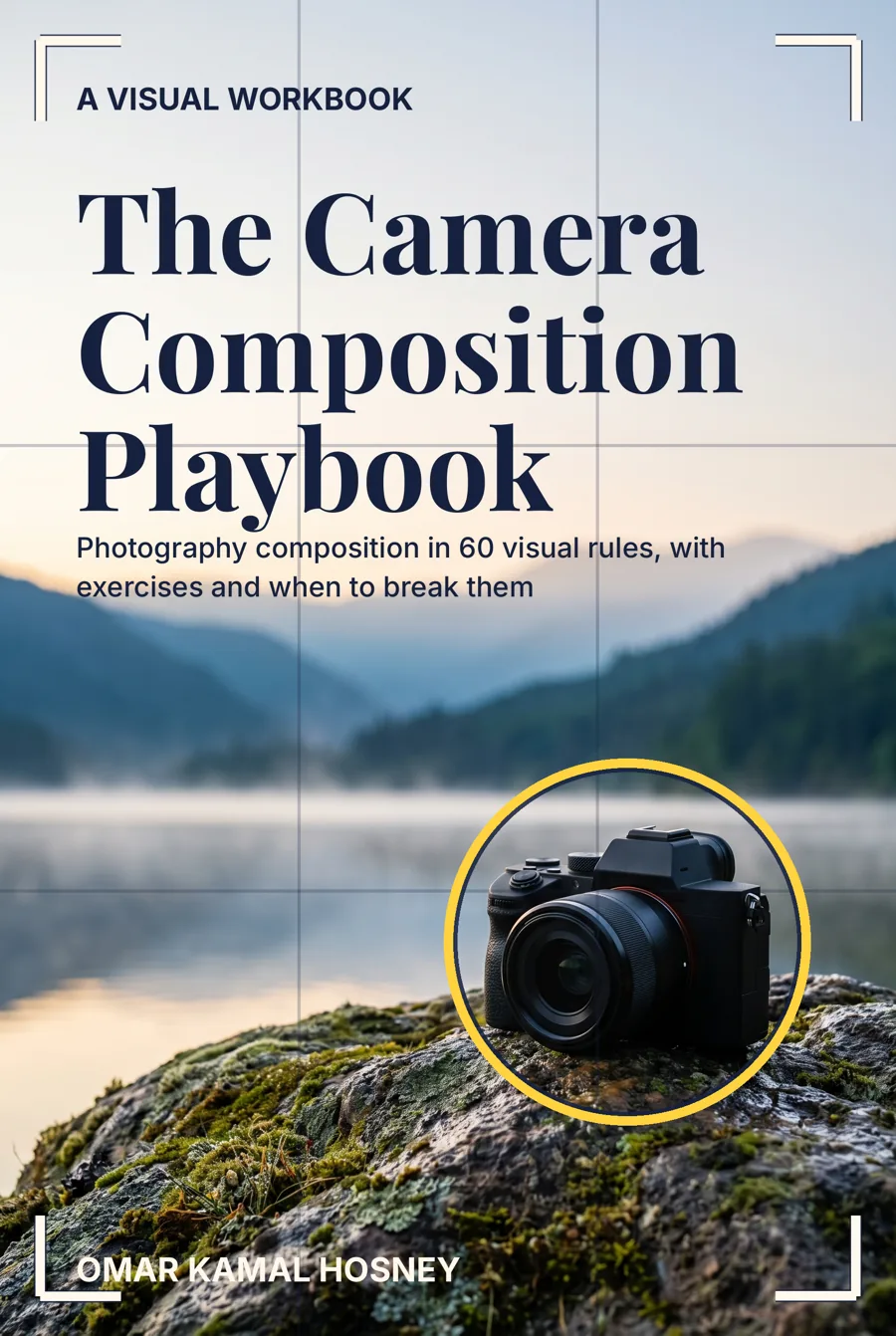
The Camera Composition Playbook
60 rules for framing a better photo. Each one shows a weaker frame beside a stronger one, gives you a 10-minute exercise, and tells you when to break it.
Any camera or phoneNo gear listsFree sample chapter
Most photos aren’t bad. They’re just unframed.
The camera records everything in front of it. Composition is the choice of what stays in the frame, and where. You can learn it one rule at a time.
Start with the problem you see, then jump to the rules that fix it.
Nothing pulls the eye in. Depth and layers add the third dimension.
Too many things compete. One clear subject and a simple background calm it down.
Everything sits in the middle. Placement and lines give the eye a path.
It feels tipped or heavy on one side. Visual weight puts it right.
Same scene. Different frame.
Drag the handle to compare. Seven of the 60 rules, exactly the way the book shows them. Turn on the grid to see where the subject sits.

 WeakerStronger
Four pages. One rule. Done in minutes.
Every rule follows the same short pattern, so you can read one in a sitting and use it on your next walk.
The idea
One sentence that tells you what to do with the frame.
Page 1 of 4See it
A weaker frame beside a stronger one, so you can feel the difference.
Pages 2–3Try it
A 10-minute exercise you can do with whatever camera you have.
Page 4Break it
When the rule stops helping, and what to do instead.
Always included60 rules in 8 Parts.
Each Part has its own colour in the book. Here they are as a contact sheet.
Foundations
The frame is a choice. Subject, background, level.
Rules 1–8- 01The frame is a choice
- 02One clear subject
- 03Simplify the background
- 04Landscape or portrait orientation
- 05Fill the frame
- 06Eye level and viewpoint height
- 07Keep it level
- 08What the eye sees first
Placement
Thirds, balance, horizon, headroom.
Rules 9–17- 09Rule of thirds
- 10Centering on purpose
- 11The golden spiral
- 12Diagonal placement
- 13Visual weight
- 14Asymmetric balance
- 15Horizon placement
- 16Rule of odds
- 17Headroom
Lines and shapes
Leading lines, curves, triangles, pattern.
Rules 18–26- 18Leading lines
- 19Converging lines
- 20S-curves
- 21Triangles
- 22Circles and curves
- 23Repetition and pattern
- 24Symmetry
- 25Pattern break
- 26Verticals and horizontals
Depth
Layers, overlap, scale, atmosphere, reflections.
Rules 27–33- 27Foreground, midground, background
- 28Overlap
- 29Scale cues
- 30Atmospheric depth
- 31Foreground interest
- 32Separating subject from background
- 33Reflections
Space and framing
Negative space, frames, cropping, edges.
Rules 34–41- 34Negative space
- 35Frame within a frame
- 36Cropping
- 37Breathing room
- 38Edge control
- 39Tangents and merges
- 40Do not cut at the joints
- 41Leading space in portraits
Light and color
Silhouettes, shadows, echoes, one accent.
Rules 42–50- 42Light as a shape
- 43Silhouette
- 44Shadows as shapes
- 45Color echoes
- 46Color blocking
- 47Limited palette
- 48Complementary colors
- 49Warm and cool
- 50A single color accent
Story and viewpoint
Angles, tension, movement, the decisive moment.
Rules 51–57- 51Subject versus context
- 52Low and high angles
- 53Top-down view
- 54Tension and awkward space
- 55Movement room
- 56The decisive moment
- 57Juxtaposition
Rhythm and flow
Rhythm, visual flow, texture and detail.
Rules 58–60- 58Rhythm
- 59Visual flow
- 60Texture and detail
A workbook you use, not just read.
Field log
A short page to note what you shot and what you noticed.
Breaking the rules
Eight situations where the rule gets in the way, and what to do.
Ten-photo weekend
A review challenge that puts the rules together.
Problem-first index
Find the fix by problem: flat, cluttered, boring, off-balance.
Cheat sheet
All the rules on one page for when you are out shooting.
Glossary
Plain-English terms, with linked contents and bookmarks in the PDF.
An honest note about the pictures
The pictures in the book are AI-generated photorealistic images, not photographs, and the book says so. The text was written with AI assistance and edited by the author. The pictures make each rule easy to see. They do not prove that a rule works on a real camera, which is what the exercises are for.
What is in, and what is not
- In: composition rules for any camera or phone, picture pairs, exercises.
- Not in: camera settings, gear lists or editing tutorials.
- Format: a 6 × 9 in PDF for screens, not a printed book.
Questions, answered plainly.
Who is this for?
Anyone who takes photos with a phone or a camera and wants them to look more deliberate. You do not need to know photography terms. The glossary explains them.
Do I need a particular camera?
No. The rules are about the frame, not the gear, so a phone is enough. The book has no camera settings or gear lists.
Are the pictures real photographs?
No. They are AI-generated photorealistic images, and the book says so. They make each rule easy to compare. The exercises ask you to try each rule with your own camera.
What format is it?
A PDF in English: 325 pages, 6 × 9 inches, in colour, about 23 MB, with linked contents and bookmarks. It is delivered as a download from Payhip.
Can I try it first?
Yes. A free sample chapter (Part 2 and Rule 9) is available on the Payhip preview page.

Start with one rule tonight.
Read the free sample first, or get all 60 rules as a PDF for $7.99.